Showing posts with label history. Show all posts

Thoughts on being a second generation geek

>> Tuesday, March 26, 2013

When I was in Toronto for our last work week,  I mentioned to one of my colleagues that I was a second generation geek.  He replied something to the effect of "There are families that have been fishing lobster for eight generations but not many second generation geeks."

I'm a second generation geek thanks to the influence of my Dad.  My sister also works in the software industry, as a technical writer.   My parents both had a tremendous influence on us.  If it wasn't for their support and encouragement, I doubt that we would be where we are today.

My Dad's first technology job was working at Burroughs  in Vancouver, BC as a field service technician and manager.  He would travel to customer sites to fix their computers, usually at banks,  insurance companies or government.  Back then computers were very large, not very common, and they had a longer lifecycle than we see today.  He had a briefcase full of tools to fix them,  given that most problems were mechanical or electrical in nature, as opposed to software.

About a decade later,  our family moved across the country and he started working as a technical services manager at a small software and services firm in Halifax, NS. This was the dawn of the PC era, and he brought home a succession of computers for him to learn about, as well as the rest of our family.  Dad would bring home stacks of computer magazines and manuals to read at nights on weekends, which I started to read as well.  We had many spirited discussions about technology, and what the future would hold.

In addition to having a wealth of technical knowledge, my Dad is also an accomplished woodworker  and builds beautiful furniture.  He bought my sister and I hammers so we could work along with him in the workshop.  There was also an abundance of Lego,  his old Meccano kit,  and stacks of science fiction books.  Christmas meant the inevitable gifts of conference swag in stockings, or a Linux book under the tree. 

Over the years, I have returned the favour and given my parents a lot of the swag I've received at work.  I'm sure they have the finest collection of Eclipse wear in Nova Scotia.  But this year begins a new tradition.


My Dad loves Firefox too

I've noticed that many of my (female) friends who work in software had a parent who worked in the industry and thus were a source of influence for their choice in career.  I learned from both my parents was to work very hard.  From my Dad, I learned that
1) Change in this industry is constant and it makes things interesting.
2) Continuous learning is essential.  Take courses, read voraciously,  break things and fix them.
3) STEM careers are for women.

Thanks Dad!

This past weekend, I asked him if there were ever any women at tech conferences when he attended them in the 1980s or 90s.  He replied that there was usually one or two, but that was all.

He then proceeded to tell me a story about a technical sales manager who he worked with for many years named Eli.  She had worked in an administrative capacity at Digital Equipment Corporation (DEC), but wanted to become a salesperson.  She was told that there was absolutely no way that she could be become a salesperson and represent DEC to customers because she was a woman.

In those days, computers were sold from OEMs (original equipment manufacturers like DEC) or VARs (valued added resellers).  The company where my Dad worked at was a VAR and had agreements with various OEMs, including DEC.  They would package hardware and software from several companies, along with installation and support services into sales proposals to meet customer requirements.  The funny thing was that VARs and OEMs would often compete for the same customers since they both sold the same branded hardware.  The VARs weren't limited to selling to a single vendor, but the OEMs had more flexibility in pricing in margins since they were the manufacturer.   Sales margins on hardware were quite high compared to what they are today, and thus a job as a salesperson could be quite financially lucrative if you were good.

Eli left DEC to work as a sales manager at the same office where my Dad worked.  She proceeded to outsell all the salesmen at her her previous employer who had refused to let her be a salesperson because of her gender, and won many sales awards.  So awesome!

I was always was a bit intimidated by Eli.  She was tough as nails, with a wicked sense of humour.  I can imagine that it wasn't always an easy path she had to walk, given that being a professional woman and working in technology was not common at the time, especially is socially conservative Nova Scotia.  But she did it, and proved that she could rise above her detractors.

A second thanks to women who have blazed trails in the past :-)  Who inspired you to choose your career in STEM?

Read more...

EclipseCon Europe presentations now available

>> Tuesday, November 15, 2011

My presentations from EclipseCon Europe are now available on slideshare.

The first one is the story of the Eclipse and Equinox team's migration from CVS to Git.


There were a lot of great presentations on  Git migrations such as those by Steffen Pingel and Christian Campo.  One thing that I've learned is that the time to migrate is proportional to the size of your code base and history.  Someone asked me if we considered just starting in Git without our history. Well, no, but that would have solved a lot of problems. It was also interesting to talk to the EGit team, and meet some of the people working at GitHub. (Thanks for the octocat stickers Kevin!). In honour of Movember, this slide seems appropriate.


Image ©dealingwith, http://www.flickr.com/photos/dealingwith/4295488113/  licensed under Creative Commons by-nc-sa 2.0

The second talk I co-presented with John Kellerman. It's a look back at the last ten years of Eclipse history. I had several people come up to me after the talk and say they really enjoyed it. Thanks! It was fun to look back at Eclipse history and dig up funny pictures and bugs. I enjoyed presenting with John because he talked about the business side and I talked about the evolution of the Eclipse community from a down in the trenches commmiter perspective. A good balance. He has been involved in the Eclipse community since well before my time, lots of great stories!

You can also listen to the talk on FOSSLC website.  I love the fact that all the EclipseCon presentations were recorded. I plan to go back to and watch the sessions I missed!

A big thank you to the organizers of EclipseCon Europe for a fantastic conference. I've never attended one before, and was very impressed. Beautiful location, interesting talks, great running paths nearby and of course, the best people. It's great to be able to spend time with people who you work with but never get to see in person, like Ian Bull and Andrew Overholt. It was also great to meet new people at lunch and in the hallways.  I talked to some first time EclipseCon attendees who were very impressed with the caliber of talks at the conference so kudos to everyone who presented.

At the IBM booth, we pinned up many pictures of the Eclipse family over the past ten years. It was great to talk to people who visited the booth, especially those new the the Eclipse community.  I posted a link to them on my Google+ account. Looking back at them it's amazing to see so many smiling people.


It's hard to believe that it's been ten years. I had a number of people come up to me at the conference and say that they couldn't believe that I had been involved in the community for ten years. Well, I can't believe it either. It reminded me of the moment when I stood up on stage to receive my university diploma and I thought, how could these four years have gone so quickly?  I don't know but it's been a lot of fun.  By the way, here is a list of other committers who have been involved with Eclipse for ten years or more.

More importantly, there are now over a thousand Eclipse committers today.  I'm honoured to work with you all :-)

Presentations on slideshare:
Migrating to Git: Rethinking the Commit
Slideshare: Has it really been 10 years?
FOSSLC recording: Has it really been 10 years?
If you look at the speakers notes, you can see the text of the talk.  Most of the slides are just pictures in "Presentation Zen" style.

Read more...

A history of lizard wrangling and other software stories

>> Friday, October 07, 2011

I've been thinking a lot lately about open source history.  I'm in the midst of preparing material for a presentation that John Kellerman and I will be giving at EclipseCon Europe about the history of Eclipse. Last week an interesting video crossed my twitter feed.  It was a talk by Mitchell Baker on the history of Mozilla.  Mitchell is the Chair of the Mozilla Foundation and Mozilla Corporation and has been involved in this community for many years.  Her title is Chief Lizard Wrangler.  That's the best job title I have ever heard.  Well, being called an astronaut would be fun too but you get the idea.  According to Wikipedia, she's a also skilled trapeze artist.  I like learning about people with interesting hobbies.


In the video, she talks about the history of  Mozilla, which started in 1998. She describes the tension between Netscape the corporation and Mozilla the community.  For instance, the belief in the Mozilla community that commit rights should be earned and voted on by your peers, not just assigned based on your employer.  It's a really interesting to learn about the conflict in those early years at Mozilla and how they worked so hard with very few resources to be where they are today.

One of my favourite lines from the talk is that "Technology alone does not change people's lives.  Our opportunity in the browser is to have a product that touches people." Also, she states that the problem with a lot of open source projects is that they are irrelevant to the marketplace and don't treat their users very well.  For instance, calling a user stupid isn't going to make their life better.  "You need to make a product that is elegant and beautiful and powerful under the covers but that people love."  Mozilla has a bit of a different outlook that the Eclipse community because their flagship product Firebox is used by everyday consumers.  Eclipse components are consumed by developers in the form of open source packages that the coordinated release provides, but at the same time many people consume components in commercial products that build upon our open source offerings.

Some other memorable lines "UI is always the most contentious issue".  Well, at Eclipse we never argue about UI.  Wait....hmm..maybe...this bug has a few contentious comments.....

This talk really resonated with me.  Eclipse and Mozilla are two well known open source communities with different histories but ultimately both are very successful.  I highly recommend taking the time to listen to it.

Happy Ada Lovelace Day from Ottawa!

Read more...

Hacker History

>> Monday, October 03, 2011

I recently read the book hackers: heroes of the computer revolution by Stephen Levy.  It looks back at the cast of characters that were involved in the early years of computing, starting in the late 1950s until the 1980s. The word hacker in this context doesn't mean someone that was breaking into machines for malicious intent, but rather someone who is breaking new ground in software and hardware.  The book is divided into three sections.  The first third of the book concentrates on people writing software at university labs such as MIT, the second third describes people making their own hardware in Silicon Valley computer clubs in the 1970s, and the final third looks at the beginnings of the PC game industry in the 1980s.

Interesting things I learned.

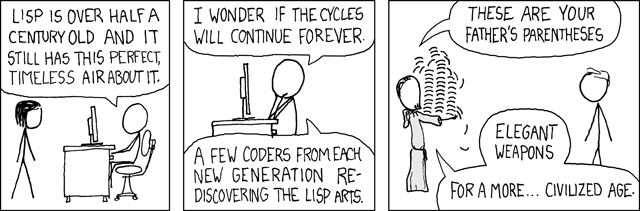
From xckd
  • LISP was invented in 1958.  Old school.
  • People used to single-handedly write a game and and then sell it to a game company such as Broderbund or Sierra On-line for a royalty on sales.  Like 30% of sales. A best selling game could make a young developer very very rich in a short period of time.
  • Silicon Valley used to be called Silicon Gulch. Silicon Valley sounds classier.
  • Bill Gates sold an early version of BASIC to a computer club which then copied it and distributed it to their members for free.  He then published a letter in a club newsletter that stated "As the majority of hobbyists may be aware, most of you steal your software."...."Who can afford to do professional work for nothing?"   A young Bill Gates writing about piracy in 1975. History repeats itself.
  • Early hackers spent days, weeks even months on end in the lab without showering.  They also didn't date much.  Coincidence? No.
  • The process to bring the Apple II to market and the interactions between Steve Jobs and Steve Wozniak were pretty interesting.
The book also talks about  the "hacker ethic", which underpins many things that we see in current open source communities today.  From the book

"Information should be free.
Mistrust authority--promote decentralization.
Hackers should be judged by their hacking, not bogus criteria such as degrees, age, race or position.
You can create art and beauty on a computer.
Computers can change your life for the better".


This book looks at the technical advancements that these hackers implemented, but is also interesting to see the culture as these nascent communities evolved. Also, it also describes the first computer conferences and magazines. It's also interesting to note the incredible passion and effort that these hackers dedicated to their  professional endeavours often had negative repercussions in their personal lives.

Anyways, if you are interested in reading about early computing history, this is a great book.   The first computer that my Dad (yes it runs in the family) brought home in the early 1980s was an Osborne , so I felt rather nostalgic reading about the this time period.
Source wikipedia

Read more...

  © Blogger template Simple n' Sweet by Ourblogtemplates.com 2009

Back to TOP