Showing posts with label learning. Show all posts

Learning Data Science and evidence based teaching methods

>> Friday, July 17, 2015

This spring, I took several online courses on the topic of data science.  I became interested in expanding my skills in this area because as release engineers, we deal with a lot of data.  I wanted to learn new tools to extract useful information from the distributed systems behemoth we manage.


This xckd reminded me of the challenges of managing our buildfarm somedays :-)
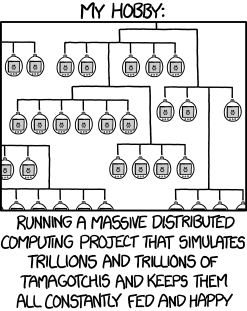
From http://xkcd.com/1546/

I took three courses from Coursera's Data Science track from John Hopkins University. As with previous coursera classes I took, all the course material is online (lecture videos and notes).  There are quizzes and assignments that are due each week.  Each course below was about four weeks long.

The Data Scientist's Toolbox - This course was pretty easy. Basically a introduction to the questions that data scientists deal as well a primer on installing R, RStudio (IDE for R), and using GitHub.
R Programming - Introduction to R.  Most of the quizzes and examples used publicly available data for the programming exercises.  I found I had to do a lot of reading in the R API docs or on stackoverflow to finish the assignments.  The lectures didn't provide a lot of the material needed to complete the assignments.  Lots of techniques to learn how to subset data using R which I found quite interesting, reminded me a lot of querying databases with SQL to conduct analysis.
Getting and Cleaning Data - More advanced techniques using R.  Using publicly available data sources to clean different data sources in different formats, XML, excel spreadsheets, comma or tab delimited. Given this data, we had to answer many questions and conduct specific analysis by writing  R programs.  The assignments were pretty challenging and took a long time. Again, the course material didn't really cover all the material you needed to do the assignments so a lot of additional reading was required.

There are six more courses in the Data Science track that I'll start tackling again in the fall that cover subjects such as reproducible research, statistical inference and machine learning.   My next coursera  class is Introduction to Systems Engineering which I'll start in a couple of weeks.  I've really become interested in learning more about this subject after reading Thinking in Systems.

The other course I took this spring was the Software Carpentry Instructor training course.   The Software Carpentry Foundation teachers researchers basic software skills.  For instance, if you are a biologist analyzing large data sets it would be useful to learn how to use R, Python, and version control to store the code you wrote to share with others.  These are not skills that many scientists acquire in their formal university training, and learning them allows them to work more productively.  The instructor course was excellent, thanks Greg Wilson for your work teaching us.

We read two books for this course:
Building a Better Teacher: An interesting overview of how teacher is taught in different countries and how to make it more effective. Most important: Have more opportunities for other teachers to observe your classroom and provide feedback which I found analogous to how code review makes us better software developers.
How Learning Works: Seven Research-Based Principles for Smart Teaching: A book summarizing the research in disciplines such as education, cognitive science and psychology on the effective techniques for teaching students new material.  How assessing student's prior knowledge can help you better design your lessons, how to to ask questions to determine what material students are failing to grasp, how to understand student's motivation for learning and more.  Really interesting research.

For the instructor course, we met every couple of weeks online where Greg would conduct a short discussion on some of the topics on a conference call and we would discuss via etherpad interactively. We would then meet in smaller groups later in the week to conduct practice teaching exercises.  We also submitted example lessons to the course repo on GitHub. The final project for the course was to conduct a short lesson to a group of instructors that gave feedback, and submit a pull request to update an existing lesson with a fix.  Then we are ready to sign up to teach a Software Carpentry course!

In conclusion, data science is a great skill to have if you are managing large distributed systems.  Also, using evidence based teaching methods to help others learn is the way to go!

Other fun data science examples include
Tracking down the Villains: Outlier Detection at Netflix - detecting rogue servers with machine learning
Finding Shoe Stores in 100k Merchants: Using Data to Group All Things - finding out what Shopify merchants sell shoes using Apache Spark and more
Looking Through Camera Lenses: The Application of Computer Vision at Etsy

Read more...

Release Engineering special issue now available

>> Wednesday, February 25, 2015

The release engineering special issue of IEEE software was published yesterday. (Download pdf here).  This issue focuses on the current state of release engineering, from both an industry and research perspective. Lots of exciting work happening in this field!

I'm interviewed in the roundtable article on the future of release engineering, along with Chuck Rossi of Facebook and Boris Debic of Google.  Interesting discussions on the current state of release engineering at organizations that scale large number of builds and tests, and release frequently.  As well,  the challenges with mobile releases versus web deployments are discussed. And finally, a discussion of how to find good release engineers, and what the future may hold.

Thanks to the other guest editors on this issue -  Stephany Bellomo, Tamara Marshall-Klein, Bram Adams, Foutse Khomh and Christian Bird - for all their hard work that make this happen!


As an aside, when I opened the issue, the image on the front cover made me laugh.  It's reminiscent of the cover on a mid-century science fiction anthology.  I showed Mr. Releng and he said "Robot birds? That is EXACTLY how I pictured working in releng."  Maybe it's meant to represent that we let software fly free.  In any case, I must go back to tending the flock of robotic avian overlords.

Read more...

Resources for learning Python

>> Monday, June 17, 2013

When I started working at Mozilla, I didn't know Python very well.  All of the code that drives our continuous integration is written in it so I've had a spent a lot of time becoming more proficient.  I've taken a number of free self-study classes/tutorials that others might find useful getting up to speed with Python.

Google Python class  - Two day class that describes how to manipulate strings, dictionaries, lists. File I/O, regular expressions and sorting algorithms.  Class lectures that were recorded at a Google training event are available on youtube, and the exercises are pretty straightforward with a solution key to check your work.  All the exercises are done using the Python installation on your local machine.

Code academy has a Python class.  I did the exercises for the topics that weren't covered in the Google class, including list comprehensions, lambda expressions and OO in Python.  The exercises are completed and validated on the website.

The best course I've taken so far has been the nine week Interactive Programming in Python class offered by Coursera. Coursera is a company that offers university courses for free.  You receive a grade and certification of completion,  but not an actual credit at the institution. The Python course I took is in conjunction with Rice University.  For this course, you have to register for the course when it's run and complete the work each week.   There are an hour or so of video lectures, a quiz or two and an assignment to complete for around 8-10 hours of work each week.  After you submit your assignment, you're asked to review the work of five other students.  This is how to scale marking assignments for the thousands of students enrolled in the class :-).  The code for your assignments is written in the browser,  on the CodeSkulptor website.

Syllabus for coursera course
Each week the assignment is to implement a different game which was a lot of fun.   We also learned how to implement the calculations for velocity, reflection and collisions to make the objects in our games appear as a realistic game.   The final project is to implement a version of the Asteroids game complete with missiles and exploding rocks.  I've also never done much with a the UI aspects of programming in the past, so it was interesting to learn how to incorporate these elements.
Screenshot of final asteroids game
This iteration of the course is almost over and the next one starts in October.  Essentially the course provides lots of time to practice writing code, which is the only path to getting better.  I found the course to be really well organized, and the video lectures were succinct in getting to the point of the lecture.  No profs going off on tangents about random subjects :-)

Mr. Releng also took this course at the same time I did as he is also using Python at work.  I said to him one day that I certainly wouldn't wanted to have attended all my university courses online as I always liked to ask questions in class.  With the pre-recorded lectures, the only way to ask questions is on the associated forums.  He agreed, but said while this was probably not the future of university, it was certainly great for continuing education.

Other Python resources I looked at  include http://www.learnpython.org/.  The pyvideo website includes talks from many of the PyCon and related conferences here which are interesting to watch.

What resources did you use to learn Python?

Read more...

  © Blogger template Simple n' Sweet by Ourblogtemplates.com 2009

Back to TOP